Physics of microarcs in low-voltage switching devices
The project aims to describe and understand low-current arcs (0.5 to 20 A) in low-voltage DC switchgears, which are increasingly important for applications like electro mobility and local grids with photovoltaic systems and batteries. Arc switching devices offer low-cost solutions combined with semiconducting devices in hybrid switchgears due to their ability to provide galvanic separation and high insulation levels. Despite decades of use, the fundamental understanding of physical processes in low-current switching arcs remains incomplete, particularly regarding unexpected behaviours of arc voltage and radiation in short gap lengths. The transfer of electric current from non-refractory cathodes, like copper alloys, to low-current arcs at atmospheric pressure poses theoretical challenges due to low thermionic electron emission. This project will tackle these issues through experimental and theoretical studies, focusing on arcs between flat cylindrical electrodes in ambient air. The investigation will evaluate the voltage-current characteristics of the breaking process, spatial arc structure, and the expected role of metal vapor and non-equilibrium conditions. A model switch will be established, employing high-speed imaging, tomography, and spectroscopy, alongside numerical simulations to create a comprehensive understanding of current transfer and arc attachment at non-refractory cathodes. The goal is to provide a self-consistent description that can explain the current-voltage characteristics and inform on switching performance, electrode erosion, and the longevity of low-voltage switching devices.
Funded by the German Research Foundation (Deutsche Forschungsgemeinschaft, DFG), project number 524731006, https://gepris.dfg.de/gepris/projekt/524731006.
Partners: Institute of Electrical Power Engineering, University of Rostock
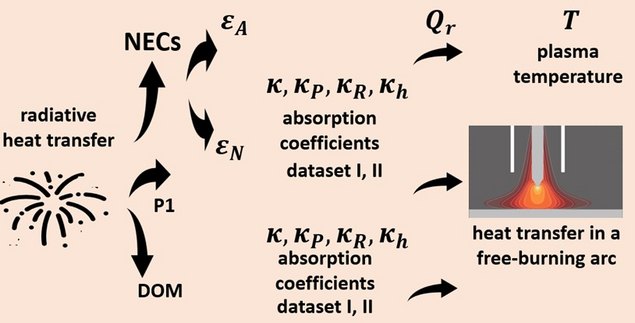
Baeva, M.; Cressault, Y.; Kloc, P. Comparative Studies on the Radiative Heat Transfer in Arc Plasma and Its Impact in a Model of a Free-Burning Arc. Plasma 2024, 7, 631–650. https://doi.org/10.3390/plasma7030033 Open Access
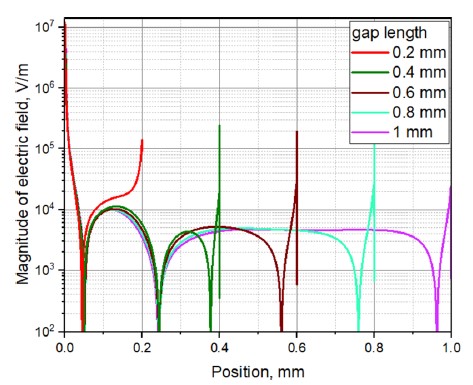
Baeva, M. Reversal of the electric field and the anode fall in DC arcs in air during contact opening, J. Phys. D: Appl. Phys. 57 (2024) 39LT01, https://doi.org/10.1088/1361-6463/ad5c73 Open Access
Kontakt
Dr. Markus Becker
Forschungsschwerpunktleiter
Smarte Datentechnologien
Tel.: +49 3834 554 3821