Plasma Bioengineering
The Plasma Bioengineering department bundles the competencies in the procedural development of processes that are based on the interaction of plasma with biological material. To this end, competencies are maintained in the development, coordination and diagnostics of plasma sources that are optimized for the task, as well as in the diagnostics of the biological systems that are dealt with. In addition, the derivation and optimization of the required process development is another focus area.
Current thematic focus areas are development of plasma processes for hygienization in the post-harvest area with an emphasis on the food sector, as well as innovative methods for process analysis and process monitoring.
Examples of the current activities of Plasma Bioengineering Department include
- Development of a hygienization procedure based on reactive nitrogen species (RNS) that enables dry treatment, as well as wet treatment with one basic device.
- Development of optical sensors for process monitoring based on special diode laser systems.
Application-oriented research work occurs predominantly on the basis of joint projects with considerable industry participation.

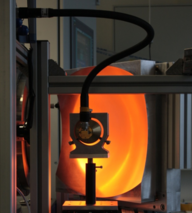
Technological equipment
Single Stage PLexc (SSP)
Single stage, self-igniting, atmospheric microwave-regulated plasma torch for RNS process gas generation (Plasma Processed Air – PPA) with process control for operation of peripheral devices, capacity: 12 slm
Auxiliary Decontamination Unit (ADU)
Dual-stage, self-igniting, atmospheric microwave-regulated plasma torch for RNS process gas generation (Plasma Processed Air – PPA) with process control for operation of peripheral devices, capacity: 100 slm
Basic Research PLexc (BRP)
Dual-stage, self igniting atmospheric microwave-regulated plasma torch for RNS process gas generation (Plasma Processed Air – EPA) with process control for investigation of fundamental process management issues, equipped with various measurement technologies (see below).
Units for generation of plasma treated water (PTW)
Total capacity 2000 l
Various peripheral devices for dry and wet treatment
... for dry and wet treatment of bulk goods, fruit and vegetables, as well as meat products in batches of up to 200 kg.
MinMIP
Small microwave-excited plasma torch for chemical diagnostics and biological applications
Microbiological standards
- Proliferation assays
- life-death determination
- biofilms
- RG1 and RG2 microorganisms
Standard methods of quality monitoring
- Water content
- sugar content
- color changes (lab system)
- Vitamin C determination
- Texture analysis
Optical measurement technology
- Optical emission spectroscopy (OES)
- Fourier-Transform-Infrared spectroscopy (FTIR)
- Thermometry
- Laser diode absorption spectroscopy
- Fluorescence microscopy
High frequency measurement technology
- Spectrum and Vector Network Analysers
- Microwave interferometers
Plasma Food Processing Pilot Plant
The Plasmalebensmittel Technikum, a state-of-the-art facility, is currently being commissioned in the Department of Plasma Biotechnology. The facility consists of a processing area with a directly adjacent Biosafety Level 2 microbiology lab, as well as a laboratory for food chemistry and physics.
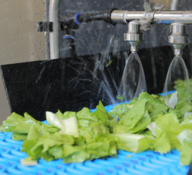
In the processing area, plants can be grown in a phytocell under controlled climatic and lighting conditions. In the adjacent climate chamber, processing operations can be carried out under controlled climatic conditions and subsequently analyzed biologically (food safety and quality). In particular, industrial processing conditions and failure scenarios can be simulated using both native and artificial microbial contamination. A Kronen HEWA 2600 is currently available for washing processes. For drying processes—such as those involving bulk materials—drum reactors and treatment chambers of various sizes are also available.
In addition to traditional disinfectants such as chlorine dioxide and hydrogen peroxide, plasma processes based on reactive oxygen species (ROS) and reactive nitrogen species (RNS) are also available, such as plasma-treated air (PPA) and water (PPW) (NOS-based) as well as ozone and ozonated water (ROS-based).
The Plasma Food Technology Center is available to external parties interested in collaborating, both through bilateral partnerships and publicly funded collaborations.
If you are interested, please contact us!
Facilities:
Processing:
- Phyto Chamber, regineering GmbH (see Climate Chamber)
- Climate Chamber, regineering GmbH (combined with a 50 kW refrigeration unit, cooling gradient 10 K/h)
- HEWA 2600, Kronen GmbH—universal washing machine for lettuce, vegetables, herbs, and fruit (capacity up to 600 kg/h)
- Ice water system, Langheinz Kältetechnik GmbH (230 L/h continuous output)
- Ozone system, ProMinent Deutschland GmbH (nominal output 70 g/h ozone)
- PPA/PPW system, autosoft GmbH (in combination with a column scrubber or in an inline configuration)
- Liquid dosing system, ProMinent Deutschland GmbH
Microbiology:
- Conventional cultivation of RG1 & RG2 microorganisms, including fungi
- Biofilm reactors
- Assay-based detection of biochemical/biophysical cell-related properties
Food chemistry & physics:
- GC-IMS & GC-MS
- IC & HPLC-MS/MS
- Refractometry
- Osmometry
- Titration
- NIRS
- Color & texture
- UV-Vis spectrometer