Plasma for Solar Materials
The Plasma for Solar Materials research group focuses on developing new material-based solutions for the sustainable use of current solar systems. A central component of the work involves plasma processes for manufacturing highly efficient solar thermal absorbers and increasing the long-term stability of perovskite solar cells.
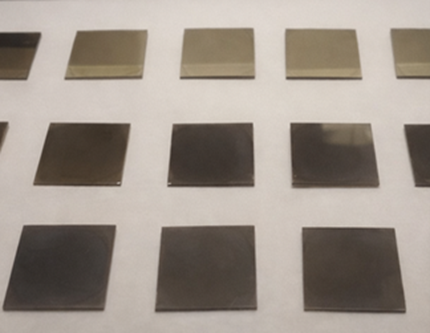
In the field of solar thermal energy, solar-selective coating systems are being developed that efficiently absorb solar radiation and limit heat loss through optimized infrared properties. One focus is on durable protective coatings that can withstand thermal and chemical stresses such as oxidation, moisture, or cyclic temperature changes, thereby increasing long-term operational reliability. In addition, work is also being done on solar-selective coatings that can specifically split sunlight according to its wavelength, for example, for the parallel use of renewable energies and agriculture.
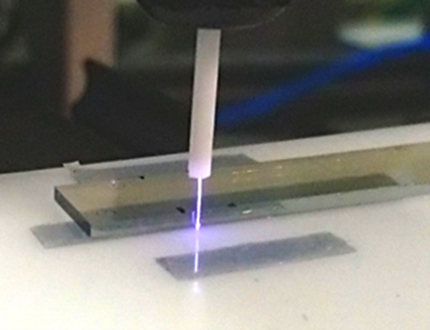
For perovskite solar cells, the focus is on plasma-based passivation and interface concepts that minimize recombination-active defects on surfaces and interfaces and slow down degradation paths. Methodologically, the group combines vacuum-based PVD coatings with atmospheric plasma treatments. Interfaces are precisely adjusted, defects are reduced, and the adhesion and barrier effect of coating systems are improved.
In parallel, we are establishing comprehensive analytics for evaluating coating structure, interface chemistry, optical properties, and aging stability. Through the close integration of process development, layer design, and characterization, we are creating a platform for developing robust material and process solutions for long-lasting perovskite photovoltaics and efficient solar thermal coatings with a view to real-world applications and collaborations along the value chain.