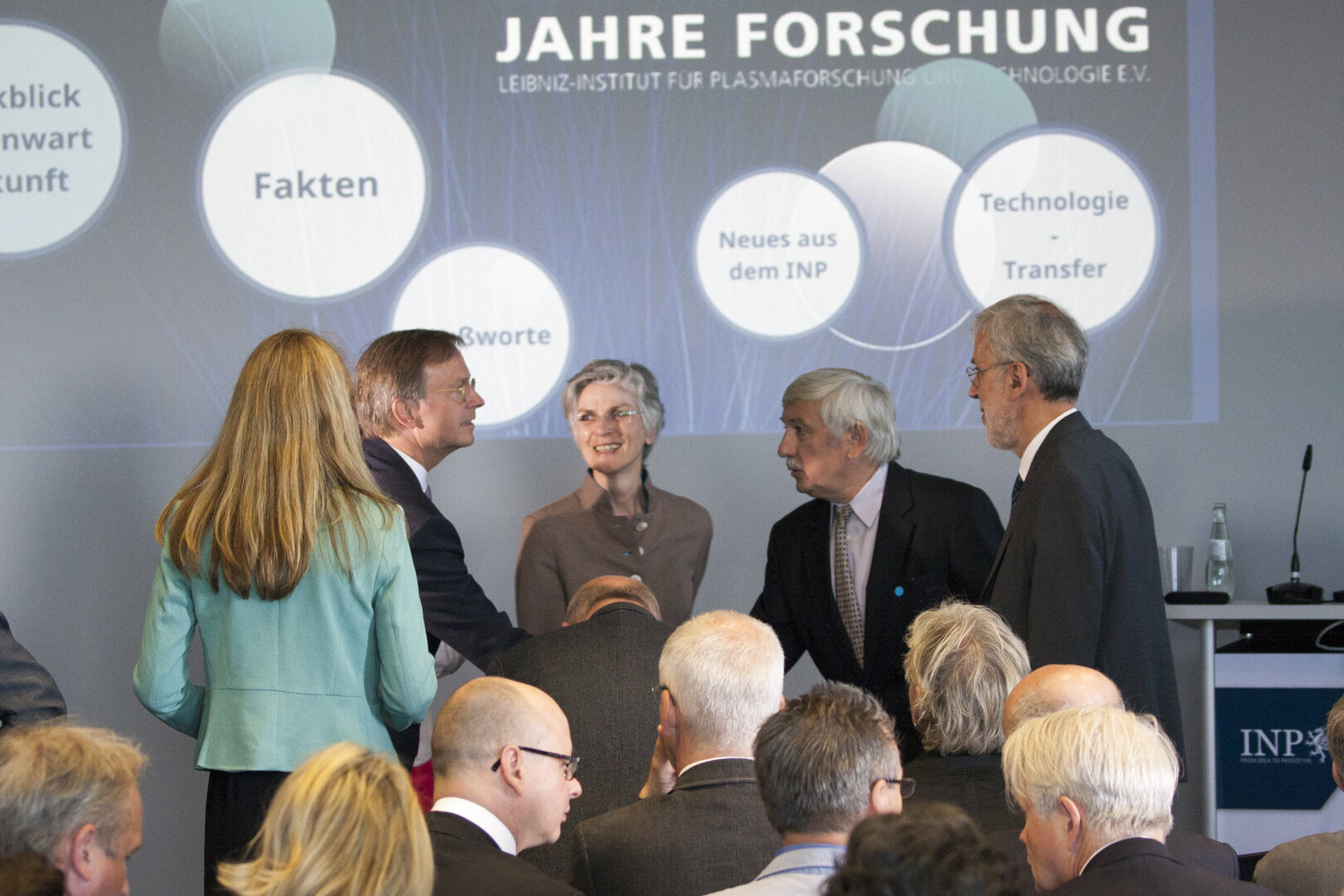
The Leibniz Institute for Plasma Science and Technology (INP Greifswald) is celebrating its twenty-fifth birthday. Around 200 guests, including friends, sponsors, companions, employees, former employees and partners of the research institute, accepted the invitation to celebrate a quarter of a century of excellent basic research and applied science at the INP.
In his opening speech at the anniversary celebrations of the Leibniz Institute for Plasma Science and Technology (INP Greifswald), INP Director Prof. Dr. Klaus-Dieter Weltmann looked back on the past and reflected on the 100-year tradition of plasma physics in Greifswald. "Thanks to the federal and state ministries and the city," the INP has earned itself a top spot in low-temperature plasma research over the last 25 years and has grown into one of the leading international institutions in this field. In his welcoming address, , Parliamentary State Secretary at the Federal Ministry of Education and Research, conveyed the special congratulations of the Federal Chancellor and noted that "… exceptional work is being done here, both nationally and internationally." Ms Birgit Hesse, Minister of Education, Science and Culture in Mecklenburg-Western Pomerania, emphasised in her speech that she was "impressed by what has been achieved at the INP".
Before Prof. Dr. Kurt Becker, Vice Dean for Research, Innovation and Entrepreneurship at NYU Tandon School of Engineering in New York, gave a guest lecture vividly describing the transfer of scientific findings into industry, Prof. Dr. Weltmann looked back on important milestones in the company's history.
In recent years, the Centre for Innovation Competence (ZIK) plasmatis at the INP, which has been funded by the Federal Ministry of Education and Research (BMBF) since 2008, has developed into an international and exemplary leader in the field of plasma medicine with a focus on wound healing. In cooperation with neoplas tools GmbH, the atmospheric pressure plasma pen called kINPen® MED was developed at the PlasmaMed campus and approved in 2013 as the world's first plasma jet as a medical device. After years of research, plasma medicine has thus successfully made the step into clinical practice. This plasma device is currently used primarily for the treatment of chronic wounds and infectious skin diseases.
In February 2016, the state-of-the-art Kompetenzzentrum Diabetes Karlsburg (Karlsburg Diabetes Competence Centre), financed by the state of Mecklenburg-Western Pomerania and the Dr. Guth Clinic Group, was officially opened. The centre integrates clinical treatment and application-oriented research in the field of plasma medicine under one roof.
In June 2015, the "arc laboratory", built at a cost of €2.45 million, was officially opened. Scientists at the INP are thus responding to the current challenges of the energy transition.
In addition to joint professorships with the universities of Greifswald and Rostock, the INP is also well positioned internationally with visiting professorships (two in the USA and one in Russia). A special milestone in international cooperation was reached with the opening ceremony on 6 February 2017 in the presence of the German ambassador in Seoul, Korea, when the transnational "Applied Plasma Medicine Centre" (APMC) was inaugurated. In future, the cooperation between the INP and its Korean partner will focus on research, development and diagnostics of physical plasmas for medical applications and their technology transfer in Asia.
Such successes contributed to the INP's excellent results in its latest evaluation by the Leibniz Association. The external evaluation committee visited the institute in 2014 and stated in its final report: “Since the last evaluation, the INP has been remarkably successful in continuing its strategic development. There is great potential for further significant progress in the coming years.”
About the institute:
Plasma, a (partially) ionised gas, is a natural phenomenon found in the sun, stars and lightning, for example. The Leibniz Institute for Plasma Science and Technology (INP Greifswald), Europe's largest non-university research institute for low-temperature plasmas, focuses its research on application-oriented fundamental research and the optimisation and development of plasma-based processes and products for the " " (cleaning, coating, processing, energy, health, safety and security). The institute conducts research and development from the initial idea to the prototype. The topics are geared to the requirements of the market. In addition to customer-specific solutions in the field of plasma technology, the INP also offers services such as feasibility studies and consulting. Currently, plasmas for materials and energy as well as the environment and health are the focus of interest. Innovative product ideas from INP research are explored directly with industry or transferred into marketable products and services through the institute's spin-offs. INP also actively promotes the training and further education of young scientists and engineers in the field of low-temperature plasma physics in cooperation with universities, research institutions and industry. The institute is organised as a non-profit association and has been a member of the Leibniz Association since its foundation.