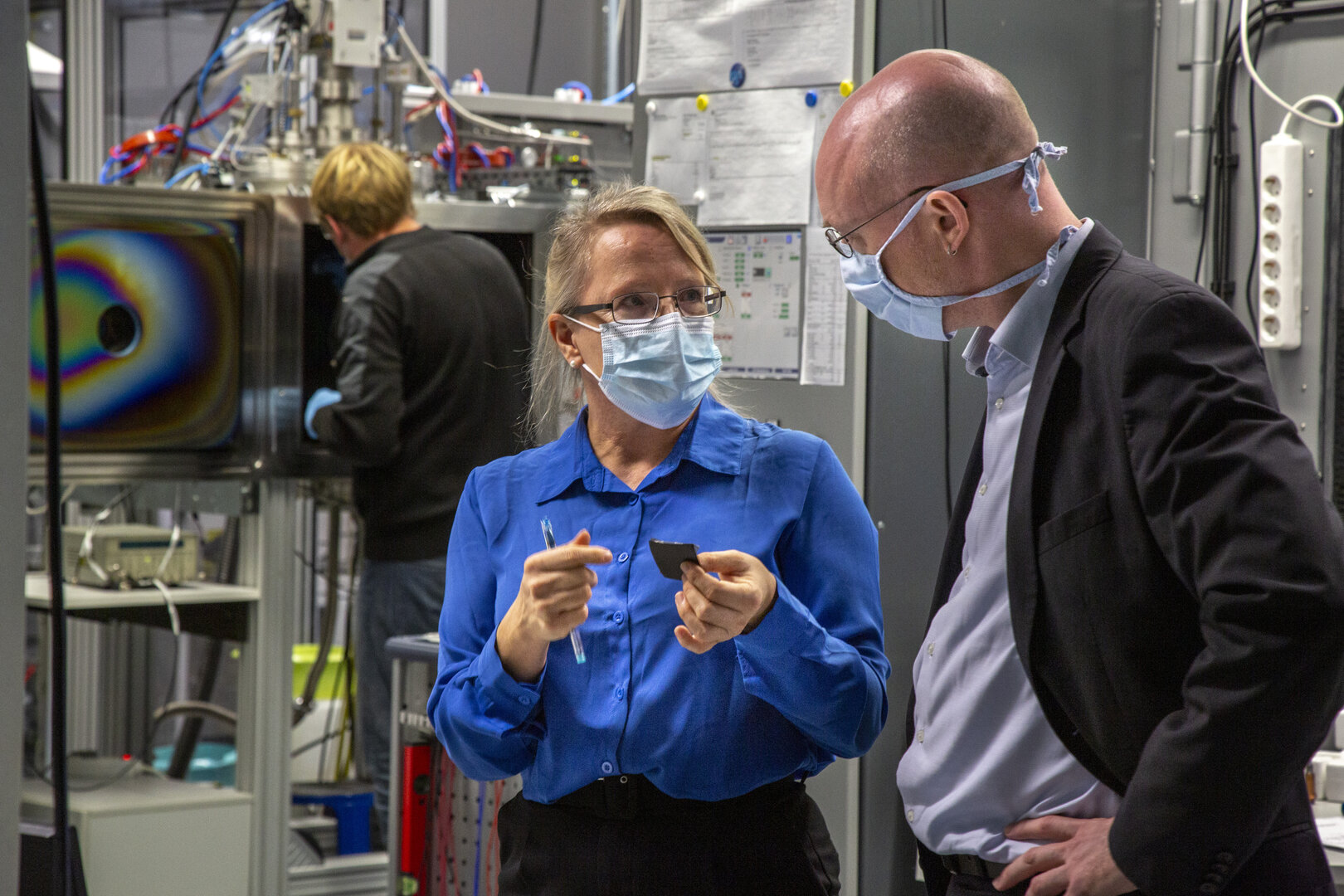
As a member of the state parliament of Mecklenburg-Western Pomerania (M-V), Christian Pegel, Minister for Energy, Infrastructure and Digitalisation (SPD), is visiting the Leibniz Institute for Plasma Science and Technology (INP) in Greifswald today. The focus of his visit will be on information about the latest developments in hydrogen technology and the technical challenges of the energy transition, as well as a tour of various research laboratories. In addition to INP's research on hydrogen technology, Christian Pegel will also learn about the latest developments in the use of cold atmospheric pressure plasmas in medicine and agriculture.
The north-east region of Mecklenburg-Western Pomerania is in the process of transforming itself into a region of the future for the energy transition. The aim is to create a future energy economy based on green ammonia obtained from air, water and locally generated renewable energies and its use in maritime mobility. Green ammonia enables a carbon-free energy supply based on hydrogen and thus provides effective, long-term economic ways of reducing the global carbon dioxide content in the Earth's atmosphere.
"We need alternatives to fossil fuels for the long-term success of the energy transition and for climate protection. Climate-friendly hydrogen production enables significant reductions in CO2 emissions, especially in industry and transport. It will play a key role as a versatile energy carrier. It is the energy carrier of the future, including the hydrogen carrier ammonia, for which the INP is conducting a major research project with various cooperation partners," said Christian Pegel. "This is a great opportunity for Mecklenburg-Western Pomerania to link the energy sector and the maritime industry."
The Leibniz Institute for Plasma Science and Technology (INP) is Germany's leading institution in the field of Plasma Science and Technology, combining basic research and applications. Together with the Leibniz Institute for Catalysis (LIKAT, Rostock) and the Fraunhofer Institute for Large Structures in Production Engineering (IGP, Rostock), the INP is playing a pioneering role in the development of cost-effective hydrogen technologies. To this end, a research factory for the production of hydrogen, ammonia and CO2-neutral carbon-based fuels (synthetic methanol or green kerosene) is to be established. Technical challenges of the energy transition are at the forefront here.
A key project led by the INP is the CAMPFIRE alliance in the North-East region as part of the WIR! pilot programme – "Change through Innovation in the Region" – run by the Federal Ministry of Education and Research (BMBF). The alliance is researching technologies for the regional and seasonal production of green ammonia (NH3) from renewable energies and its use as a carbon-free energy storage medium and fuel in maritime mobility. Innovative manufacturing processes for electrodes, membranes and corrosion protection coatings have been developed as key components for hydrogen technology at the INP in collaboration with partners for several years.
Minister Pegel is familiar with the CAMPFIRE project and has been following it with great interest since its inception in 2019. In the first project phase, ten CAMPFIRE joint projects are being funded with 8 million euros. The alliance currently consists of over 40 mainly regional but also supraregional partners, such as research institutions and companies from the shipbuilding and shipping industries, energy technology and a major consumer of hydrogen from the fertiliser industry based in the region. NH3 is the perfect hydrogen storage medium and has a volumetric energy density comparable to that of methanol. It can be liquefied at minus 33 °C or at normal temperature at a low pressure of 8 bar and can therefore be stored, transported and handled easily and safely in an economical manner. At the heart of CAMPFIRE's new " " energy technologies are electroceramic thin-film membranes based on complex metal oxides. These enable high efficiency and a long service life for the new technologies, e.g. in the production of the new energy carrier ammonia using innovative electrolysis processes, as well as in crackers for the use of ammonia as a fuel in shipping, engines and fuel cells.
M-V is pursuing the steady expansion of energy production based on wind power, solar technology and biomass. The high storage costs involved in ensuring a secure supply of fluctuating renewable energy are a critical issue here. Power-to-X products such as carbon-free ammonia or biogenic methanol and kerosene are important door openers for the energy transition and open up sustainable business models for regional companies beyond small pilot projects.