An innovative technology that combines ultrasound and plasma processes is set to significantly improve the breakdown of organic compounds, thereby increasing the economic efficiency of biogas plants.
Mecklenburg-Western Pomerania is a leader in the implementation of the energy transition. The north-east already covers more than a third of its primary energy needs from renewable sources. In order to continue this development, the efficiency of energy production must be increased, as there is less and less capacity for expansion. While new generations of wind turbines are already being installed, the retrofitting of biogas plants, which generate 17 per cent of the electricity in Mecklenburg-Western Pomerania, is also becoming more important. These technical issues are being addressed in a project run by the Leibniz Institute for Plasma Science and Technology (INP), the University of Rostock and the company PRE Power Recycling Energyservice from Neubrandenburg. The two-year joint project is being funded by the State Ministry of Economics, Labour and Health with one million euros.
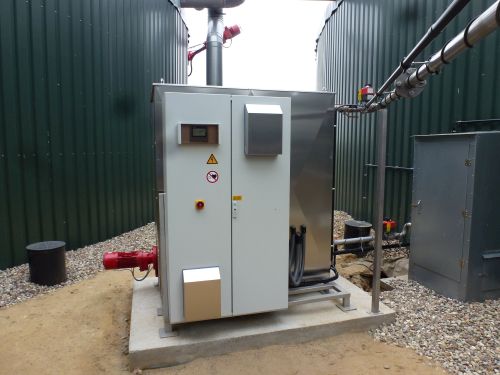
The project aims to improve the processing of input materials – plant waste, manure, sewage sludge and biowaste – in fermentation processes. In conventional plants, only around 65 percent of the difficult-to-degrade organic components are broken down by bacteria and mainly converted into methane. The rest remains unused. Ultrasound can be used to recover some of the previously unavailable organic matter and use it to generate energy, as demonstrated by the "Wave Box" (see figure) developed by research partner PRE . This experience forms the basis for the innovative "Kombi-Max" device, which combines ultrasound and plasma processes.
The project participants expect the synergy of both technologies to result in a quantum leap in the efficiency of breaking down organic compounds. One focus is on investigating suitable plasma sources that can be used in conjunction with ultrasound to optimise the process. The researchers are particularly interested in biomolecular compounds that are difficult to break down, such as lignin, but also undesirable chemicals. At the same time, the scientists want to use the new process to reduce nitrogen emissions.
"We have good reason to hope that the use of both technologies will significantly increase the efficiency and thus the economic viability of biogas plants," says Volker Brüser, head of the Plasma Process Technology department at INP and responsible for a sub-project of "Kombi-Max". This is of great importance for the future of this energy technology. Norbert Rossow, managing director of PRE, emphasises: "With our high-performance ultrasonic device, the Wave Box, we have achieved a very good efficiency increase of up to 20 percent in biomass processing for biogas plants. The combination of both digestion systems in the new device type will multiply the efficiency increase, as can be seen from scientific publications. We expect a significant reduction in the amount of energy used, a doubling of the degree of breakdown and a significant reduction in the size of the device." The collaboration between INP and PRE Neubrandenburg and the first design steps for the new device have already resulted in a new international patent for both partners. Industry-oriented tests of the demonstration plant are planned for 2020.