Christian Pegel, Minister for Energy, Infrastructure and Digitalisation, sees the CAMPFIRE research project as an opportunity for Mecklenburg-Western Pomerania to increase local value creation and acceptance of the energy transition.
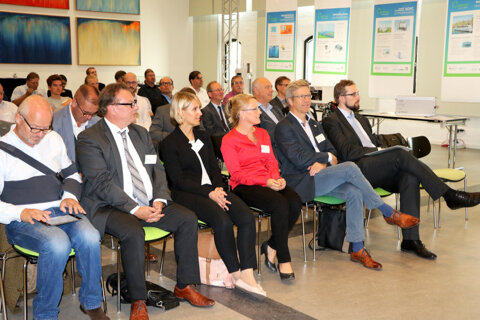
Stralsund. As part of the research project "CAMPFIRE: Fuels from wind and water – energy and maritime mobility transition in the North-East region", the Institute for Climate Protection, Energy and Mobility, the Leibniz Institute for Plasma Science and Technology and Stralsund University of Applied Sciences held an expert workshop at the Ozeaneum in Stralsund on 11 September 2018. Around 70 representatives from politics, business and science discussed the use of new technologies for a maritime mobility transition in the north-east region of Mecklenburg-Western Pomerania. The workshop was a highlight on the road to a research project in which green energy sources such as ammonia and hydrogen are to be produced for maritime mobility from locally generated wind power. Innovative membrane technologies from the north-east region will be used in the propulsion systems.
"Emissions-free ship propulsion systems offer a great opportunity for Mecklenburg-Western Pomerania: locally generated wind power is used to make shipping climate-friendly," said Christian Pegel, Minister for Energy, Infrastructure and Digitalisation of the State of Mecklenburg-Western Pomerania, in his welcoming address. "This could enable two key economic sectors – renewable energies and the maritime industry – to generate more added value for the region and increase acceptance of the energy transition."
During a five-year implementation phase and beyond, until 2030, the research project aims to help innovative membrane components achieve a commercial breakthrough in new energy technologies. In addition, new types of ship propulsion systems are to be developed that use green energy sources such as ammonia and hydrogen. These can be produced in a climate-friendly manner from locally generated wind power and represent a first step towards regional sector coupling.
The north-east region around the cities of Rostock, Stralsund, Greifswald and Neubrandenburg is one of the most important regions for the future of decarbonised energy supply. "Companies across Europe are working on a network for hydrogen mobility to achieve the goals of the Paris Climate Agreement," said Jorgo Chatzimarkakis, Secretary General of Hydrogen Europe, the European association for hydrogen and fuel cells. "Mecklenburg-Western Pomerania is characterised by its large wind capacity. Its geographical location makes the federal state ideally suited to build a bridge between Central Europe and the countries bordering the Baltic Sea."
To protect the climate, approaches for the maritime sector are also urgently needed. In 2016, this sector was responsible for 3.3 per cent of global greenhouse gas emissions. This is roughly equivalent to Germany's total greenhouse gas emissions in one year. With growing global trade, significant growth in global maritime freight transport is expected in the long term. At the same time, greenhouse gas emissions in this sector are also growing. In April 2018, the International Maritime Organisation (IMO) therefore presented a strategy aimed at decarbonising maritime transport by 2050. This is where the CAMPFIRE research project comes in.
CAMPFIRE: Fuels from wind and water – energy and maritime mobility transition in the North-East region
A total of 26 alliance partners, including nine small and medium-sized enterprises, five large companies, six research institutes and four universities, are part of the research project. CAMPFIRE is an initiative of the "WIR! - Change through Innovation in the Region" funding programme of the Federal Ministry of Education and Research. "The number of regional alliance partners has grown steadily, demonstrating that the region has a wealth of expertise and innovative entrepreneurial spirit for the maritime mobility transition," summarises Dr Angela Kruth, project coordinator at the Leibniz Institute for Plasma Science and Technology in Greifswald.
The expert workshop in Stralsund was an important milestone in the development of the project: "In addition to technical discussions, the event focused on practical exchanges on the use of new membrane technologies and the future design of the energy and maritime mobility transition in the North-East region," explains researcher Kruth. "During the workshop, it became clear how strong the support for the project is in the region."
This was also confirmed by the Mayor of Greifswald, Dr Stefan Fassbinder, and Heino Tanschus, Head of Public Order and Deputy Mayor of Stralsund, at the event in the Ozeaneum: "The energy transition and an emission-free Baltic Sea are issues of great importance for our region," emphasised Fassbinder. Tanschus also hopes that the CAMPFIRE research results will strengthen the Hanseatic cities as research and business locations and create new, highly skilled jobs in the region.
Other coordinators of the Campfire sub-projects are the Institute for Climate Protection, Energy and Mobility and Stralsund University of Applied Sciences with project managers Simon Schäfer-Stradowsky and Prof. Johannes Gulden.
Contact:
Franziska Hagen
Event Management & Public Relations
Tel.: +49 3834 554 3886
franziska.hagen@inp-greifswald.de