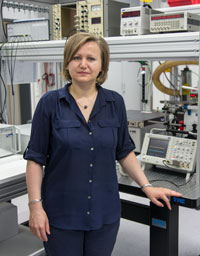
They are young, motivated and highly educated, but they are turning their backs on Europe. German research institutions would like to win back these excellent scientists. In the case of Dr Camelia Miron, they have succeeded. The plasma physicist has been conducting research at the Leibniz Institute for Plasma Science and Technology (INP) in Greifswald, Mecklenburg-Western Pomerania, for a year now, rather than at Nagoya University in Japan.
Camelia Miron actually had a secure job in Japan. It was well paid and she enjoyed the research work. "But as soon as I received the request from the INP, I decided to return to Europe," says the 38-year-old, who spent seven years in Japan specialising in "plasma in liquids". The decision to join the INP in Greifswald was based on professional reasons: only here are the two thematic areas of plasma medicine and bioelectrics combined in one institute, which form the basis for the further development of her field of research.
Camelia Miron's scientific work focuses on the development of innovative plastics. These are more water-repellent than conventional plastics and could therefore be of great importance for medicine as catheters in blood vessels. They would prevent blood cells from sticking to the catheter, thus reducing the risk of blood clots.
"At INP, everything is done to ensure that I can conduct good research," says Camelia Miron. She works in laboratories with excellent and, in some cases, globally unique equipment. Last year alone, INP invested EUR 6.7 million in new equipment and laboratories. "I also have an environment that gives me enough freedom to establish new contacts with other scientists," she adds. And because the INP particularly encourages participation in international conferences, the scientist is able to give lectures on her research findings worldwide. This has enabled her to gain new project partners, such as Dr Eugen Stamate from the Technical University of Denmark (Roskilde). Together, they will investigate how the innovative plastics can be manufactured. To intensify their collaboration, Camelia Miron has already invited her project partner from Denmark to the INP Greifswald for a research stay. She is convinced that "planning the experiments and discussing the results will be much easier this way." The INP is providing half a million euros in EU funding for this type of scientific exchange with international cooperation partners.
Camelia Miron is very happy with her decision to return to Europe: “I like the fact that the INP provides me with such comprehensive support, both professionally and personally. Here I find the perfect conditions for expanding my field of research.”
The INP Greifswald currently employs 120 scientists in the field of low-temperature plasma physics. This makes the INP the largest non-university research institute for this field in Europe. The PlasmaShape project provides versatile support for international scientists at INP Greifswald. This EU-funded project aims to expand excellent research at INP to an international level.