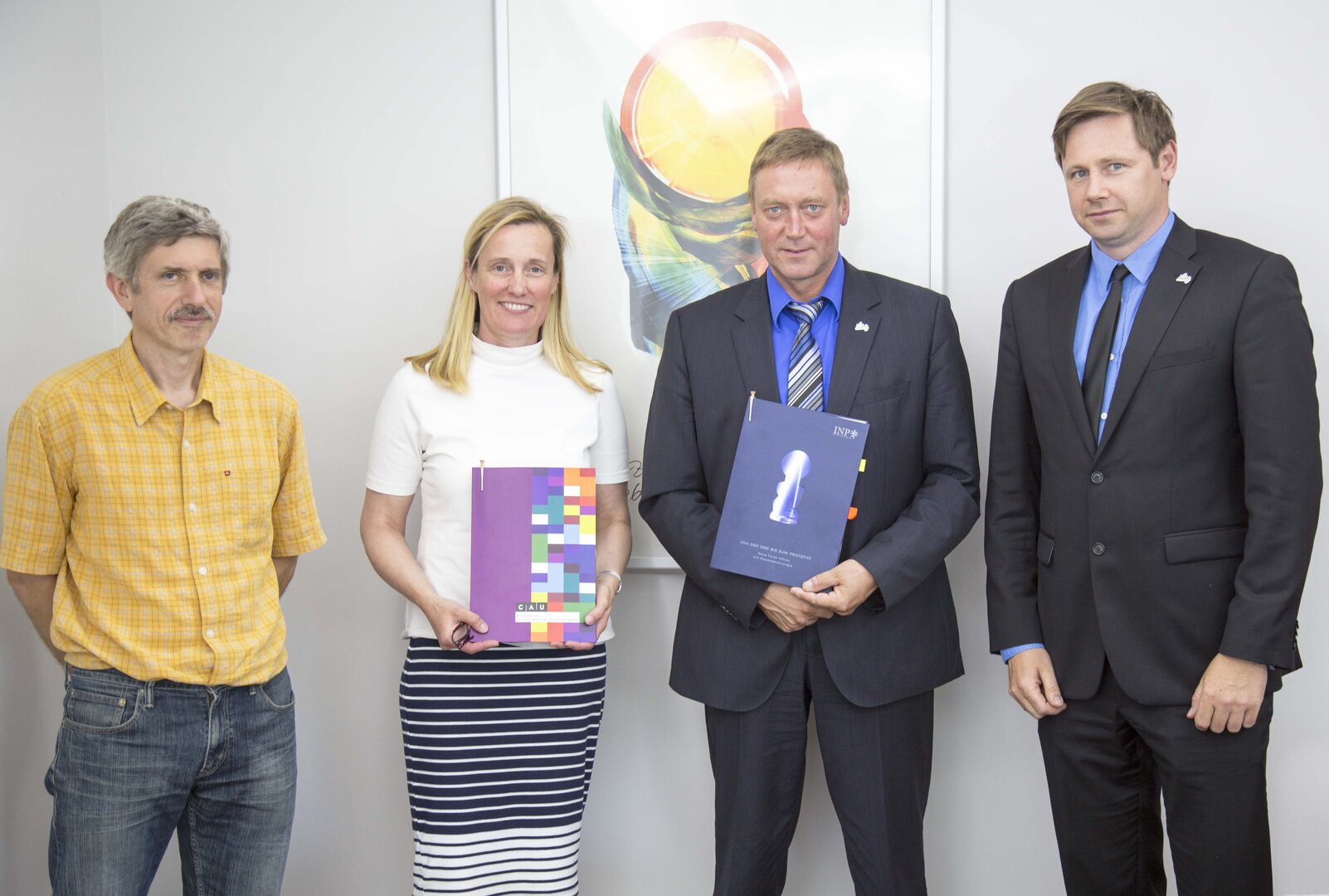
Christian-Albrechts-Universität zu Kiel (CAU) and Leibniz Institute for Plasma Science and Technology (INP Greifswald) will collaborate even more closely in the field of low-temperature plasma physics. The cooperation agreement was signed at the INP.
Greifswald/Kiel, 09.06.201
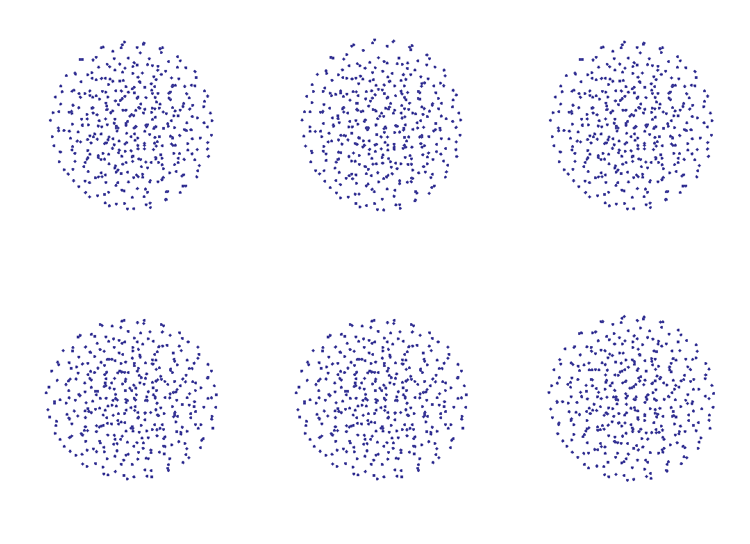
The cooperation agreement covers a range of areas. In particular, computer simulations will be developed to improve our understanding of the interactions between plasmas and surfaces. The two partners complement each other perfectly thanks to their different areas of expertise and experience: the Greifswald researchers can use model calculations to describe individual plasma effects in detail and create complete simulations of how various plasma devices and processes work. The theoretical physicists at Kiel University, on the other hand, have extensive experience in developing new theoretical and numerical methods for describing complex plasmas and solids.
"Previous research has mostly focused either on the various processes at surfaces or on the investigation of plasmas," explains Dr Markus Becker, research associate in the Plasma Modelling Department at INP. The collaboration between the INP and the Institute of Theoretical Physics and Astrophysics (ITAP) at Kiel University aims to bring both research areas together to understand the fundamental effects of the interactions between surfaces and plasmas.
The first joint investigations began about a year ago on the initiative of Prof. Michael Bonitz, Chair of Statistical Physics at ITAP, and Prof. Klaus-Dieter Weltmann, Scientific Director and Chairman of the Board of INP Greifswald e.V. "At a conference, we identified broad areas of common professional interest in the field of low-temperature plasmas," recalls Bonitz. This led to discussions on how the two institutions could cooperate in the future. "Next, we will establish a joint junior research group with two postdocs and two doctoral students," explains Weltmann. The two groups are now working closely together. The current research in the field of computer simulation is important preliminary work for joint projects in a new Kiel-based collaborative research centre on plasma-surface interactions, the concept for which has been submitted to the German Research Foundation (DFG).
In order to promote long-term cooperation between the two institutions, the cooperation agreement provides for a wide range of joint measures.
Young scientists in particular will be offered prospects for close integration of research and teaching through possible joint appointments of professors. Students and doctoral candidates will be presented with the latest research results and will be able to actively contribute new approaches and ideas to basic and applied research.
The Leibniz Institute for Plasma Science and Technology (INP Greifswald)
Research and development from idea to prototype – With more than 165 scientists, engineers and other specialists, the INP in Greifswald is one of Europe's leading non-university research institutions for low-temperature plasmas, their fundamentals and technical applications. In addition to application-oriented fundamental research, the Leibniz Institute promotes the development of plasma-based processes and products. The topics are geared to the requirements of the market. The INP thus offers customer-specific solutions in the field of plasma technology as well as services such as feasibility studies and consulting. Currently, the focus is on plasmas for surfaces and materials, environmental and energy technology, and interdisciplinary topics in biology and medicine. Innovative product ideas from INP research are ultimately investigated directly with industry or transferred into marketable products and services through the institute's spin-offs.
Christian Albrecht University of Kiel (CAU)
Details that are only a millionth of a millimetre in size: this is the focus of one of the four research programmes at Kiel University (CAU): "Nanoscience and Surface Research" (Kiel Nano, Surface and Interface Science – KiNSIS). Through intensive interdisciplinary collaboration between materials science, chemistry, physics, biology, electrical engineering, computer science, food technology and various medical disciplines, the focus is on understanding systems in this dimension and applying the findings in practice. This can result in molecular machines, novel sensors, bionic materials, quantum computers, advanced therapies and much more. The Statistical Physics working group researches classical and quantum many-body systems, from dense and dusty plasmas to atoms, molecules and strongly correlated solids.