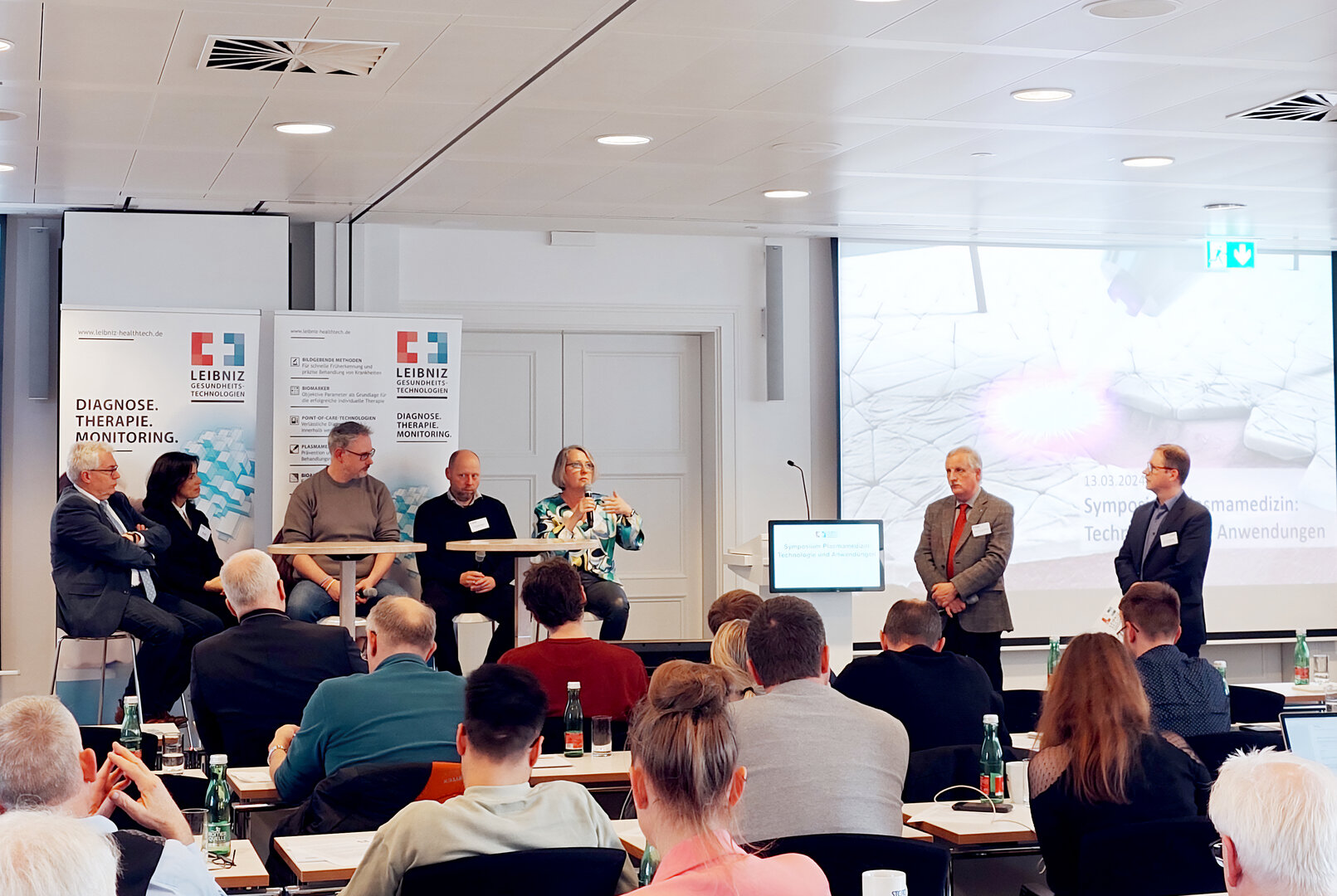
Germany plays a leading global role in research, development, and translation of plasma technologies. With the symposium "Plasma Medicine: Technology and Applications," the research network "Leibniz Health Technologies" (LGT) once again highlighted this future-oriented technology. Held on March 13, 2024, at the Karl Storz Visitor and Training Center in Berlin, the event brought together leading researchers and representatives from industry. The discussions focused on practical applications of cold plasma, potential partnerships between research and industry, as well as pathways to regulatory approval and reimbursement.
Organized by Leibniz Health Technologies and researchers from the Leibniz Institute for Plasma Science and Technology (INP), the symposium was dedicated to the medical application of cold plasma technologies. Experts from renowned institutions and companies presented technological developments, clinical studies, and application examples in the fields of wound healing, dentistry, and cancer therapy.
Prof. Klaus-Dieter Weltmann and Prof. Thomas von Woedtke from the Leibniz INP opened the event with an overview of the rapid development of plasma medicine over the past 15 years and the current possibilities of cold atmospheric pressure plasma in medical practice. Further presentations highlighted various aspects of plasma medicine, including clinical evidence of the wound-healing effect of cold plasma, presented by Dr. Lars Böckmann from the University Medicine Rostock, and the opportunities and perspectives for plasma applications in cancer treatment, presented by Prof. Sander Bekeschus from the Leibniz Institute for Plasma Science and Technology and the University Medicine Rostock.
Plasma medicine on the way to standard care
Dr. Christian Eberhard of Dentsply Sirona Deutschland GmbH presented the pathway from laboratory testing to clinical trials on patients for a plasma application in dentistry. He especially addressed the challenges of documentation necessary for regulatory approval of new medical devices.
Prof. Hans-Robert Metelmann from University Medicine Greifswald also presented a G-BA (Federal Joint Committee) pilot study currently in preparation. According to experts, this study could mark a decisive breakthrough for plasma medicine, as it could pave the way for reimbursement by health insurance companies and establish cold plasma as a routine therapy option.
Panel discussion of leading cold plasma companies as a highlight
A key highlight of the symposium was the panel discussion on "The plasma medicine market from a company perspective." Representatives of various companies, including Stefanie Ascher from terraplasma medical GmbH, Dr. Benedikt Busse from Cinogy System GmbH, Dr. Carsten Mahrenholz from Coldplasmatech GmbH, and Ulrike Sailer from neoplas med GmbH, provided their insights into the current market and future developments. The panel also included the perspective of a clinician, Prof. Dr. Steffen Emmert – dermatologist at University Medicine Rostock and chair of the Scientific Advisory Board of LGT.
The experts on the panel agreed that plasma medicine has made remarkable progress in recent years. Key to this progress is the close collaboration between research and industry, enabling faster translation into medical products. The broad range of presented applications impressively demonstrated the enormous potential of plasma medicine. The discussion provided valuable insights into both the challenges and opportunities in the plasma medicine market and concluded the symposium.
Ulrike Sailer, CEO of LGT partner neoplas med, stated: "The symposium offered an excellent platform to revitalize valuable contacts, make new ones, and explore potential cooperation opportunities. I am confident that these new connections can lead to sustainable collaborations in the future. It was a very successful event, which will certainly help further drive the development of plasma medicine."
About Leibniz Health Technologies
Leibniz Health Technologies is a research network within the Leibniz Association. In this consortium, 16 Leibniz Institutes work together with industry partners on concrete technological solutions for pressing medical questions. Their joint goal is to improve medical care for patients. Through an interdisciplinary approach, prevention, diagnostics, and therapy are intended to merge, thereby enhancing quality of life. Plasma medicine is one of five interdisciplinary areas of expertise forming the main research pillars of Leibniz Health Technologies.
The Leibniz research network brings together expertise from a wide range of scientific fields: from photonics and medicine, to microelectronics and materials research, to economic research and applied mathematics. In this way, health technologies are created and brought to market maturity in close partnership with industry, clinics, insurance companies, and policymakers along a seamless innovation chain. At the same time, Leibniz Health Technologies also researches the social and economic impacts of new medical technologies in order to maximize benefits for users and foster broad societal acceptance of new technologies.
Further information
Leibniz Health Technologies
Christian Döring // Public Relations
Tel.: +49 3641 948 391 // doering@leibniz-healthtech.de
Philosophenweg 7 (ZAF) // 07743 Jena // www.leibniz-healthtech.de
Leibniz Institute for Plasma Science and Technology (INP)
Stefan Gerhardt // Communications
Tel.: +49 3834 554 3903 // stefan.gerhardt@inp-greifswald.de
Felix-Hausdorff-Straße 2 // 17489 Greifswald // www.leibniz-inp.de