Prof. Thomas von Woedtke was appointed to the Board of Directors of the Leibniz Institute for Plasma Science and Technology (INP) at the last meeting of the Board of Trustees in June.
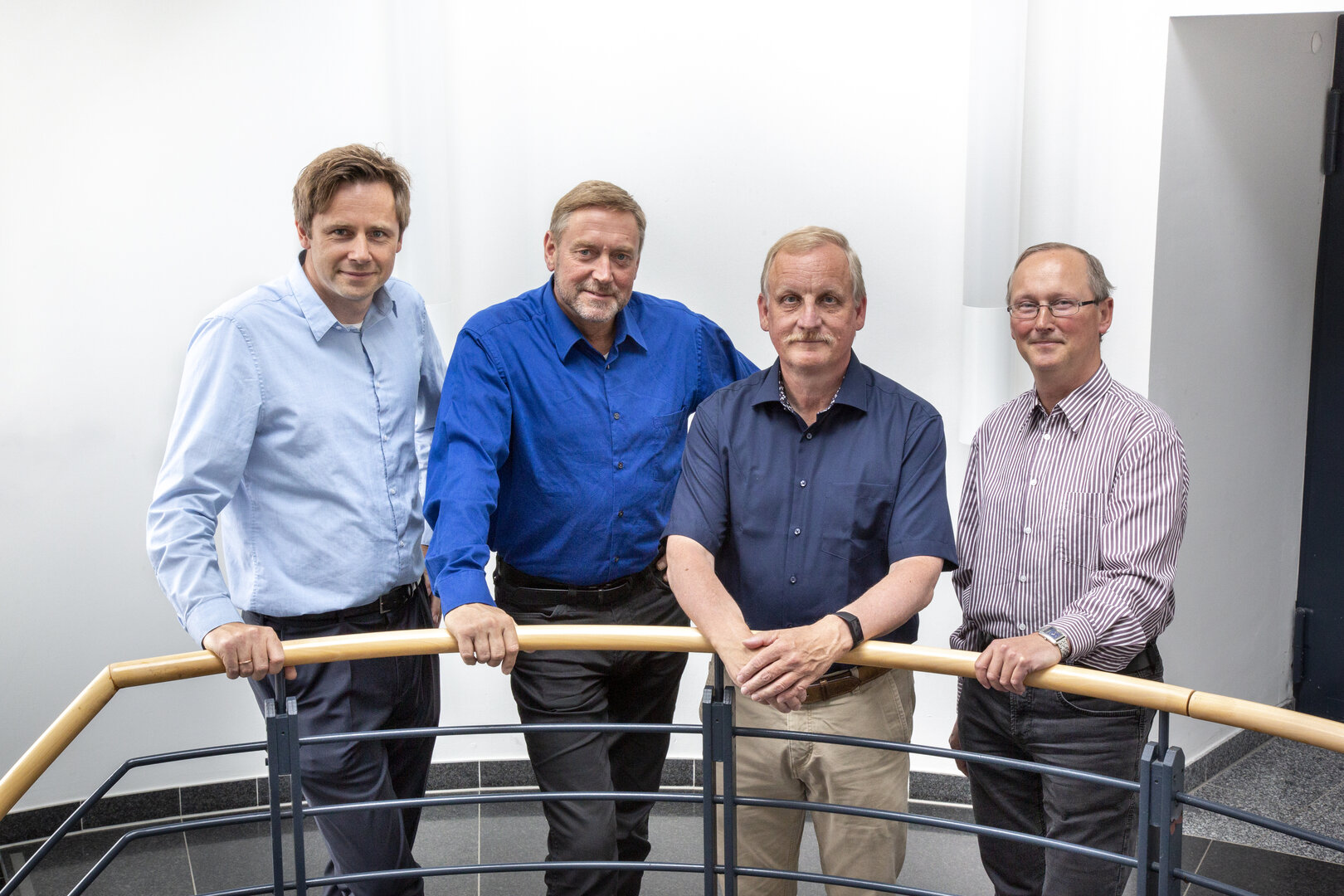
The head of the Plasma Medicine research programme, Prof. Thomas von Woedtke, was unanimously elected as a new member of the Board of Directors by the members of the Board of Trustees in June. "The appointment of Prof. v. Woedtke strengthens the interdisciplinary scientific basis of the Board of Directors," said Prof. Klaus-Dieter Weltmann, Chairman of the Board of Directors and Scientific Director of the INP. With his appointment, the Greifswald-based pharmacist joins Prof. Klaus-Dieter Weltmann, Prof. Dirk Uhrlandt and Jens Berger to complete the four-member management team of the Greifswald Leibniz Institute. During his initial five-year term, he will focus in particular on promoting young talent and research, public relations, and scientific and operational activities. "I am very much looking forward to my new role and the challenge of working with my colleagues to support and advance the work in the individual areas," explains Prof. v. Woedtke.
At the same time, the Board of Directors bids farewell to Ms Nadja Dahlhaus, who will be taking on new responsibilities in the field of public relations at the INP at the end of her term of office. "We would like to thank Ms Dahlhaus very much for her many years of intensive and reliable work on the Board of Directors. Thanks to her commitment, we have been able to break new ground, particularly in the area of administration, and we are losing a valued and loyal partner on the Board," said Prof. Weltmann.
Prof. von Woedtke has been working at the INP for fifteen years. Since 2008, he has been Scientific Director of the Plasma Medicine research programme. In 2011, he also took up the world's first professorship in plasma medicine at the University Medical Centre Greifswald. Prof. von Woedtke's research focuses primarily on the in vitro effects of physical plasma on liquids, organisms and cells with a view to scientifically preparing and supporting therapeutic applications. The main goal of this work is to improve the characterisation and control of the physical properties of cold atmospheric pressure plasmas in interaction with living systems in order to redesign and optimise plasma devices for medical applications and thus open up new areas of application.
About INP Greifswald:
At the Leibniz Institute for Plasma Science and Technology (INP), the largest non-university research facility for low-temperature plasmas in Europe, around 200 employees conduct research into plasma-based processes and technologies that can be used for coating surfaces, decontaminating food, purifying waste water and exhaust air, as well as in the medical industry and electrical engineering. The institute conducts application-oriented fundamental research and offers its industrial partners customer-specific solutions as well as services such as feasibility studies and consulting. Many of the innovations developed at INP have already led to the development of marketable products and services. The INP also actively promotes the training and further education of young scientists and engineers in the field of low-temperature plasma physics in cooperation with universities, research institutions and industry. It is organised as a non-profit association and has been a member of the Leibniz Association (www.leibniz-gemeinschaft.de) since its foundation.
What is plasma?
We encounter plasma every day, even if we are hardly aware of it. Approximately 90% of the visible matter in the universe is in a plasma state. It is the fourth state of matter after solid, liquid and gas. The electrically conductive mixture of atoms, ions, electrons and molecules is created when energy is added to a neutral gas. It begins to glow. We encounter this natural phenomenon in nature in the form of the sun, lightning and the aurora borealis.