Leibniz Institute for Plasma Science and Technology and Neubrandenburg University of Applied Sciences launch innovative project for the agricultural sector
Advancing climate change poses major challenges for agriculture. Increasingly extreme weather conditions are leading to drastic crop failures, and rising temperatures are also expected to cause the spread of new plant diseases. This is where a project by the Leibniz Institute for Plasma Science and Technology (INP) in Greifswald and the Neubrandenburg University of Applied Sciences comes in. As part of the "Physics for Food" project funded by the Federal Ministry of Education and Research under the "WIR! - Change through Innovation in the Region" funding programme, the researchers want to develop a strategy to make seeds more viable and robust using physical technologies. One focus is on the application of cold plasmas. Studies have shown that this pollutant-free process can accelerate plant growth and increase their resistance.
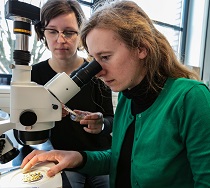
The researchers from Mecklenburg-Western Pomerania are focusing on cereal crops such as wheat and barley, whose seeds are often treated with chemical dressings. They are also investigating how the germination of legumes such as red clover and alfalfa can be optimised. These are considered an important building block on the path to more sustainable agriculture. "We want to help reduce the use of pesticides in the fields," emphasise biologists Dr Henrike Brust and Dr Nicola Wannicke, who are part of an interdisciplinary team at the INP researching the effects of plasmas on plants. In view of the expected tightening of EU regulations on plant protection products, alternatives must be found to continue to combat pathogens such as fungi and bacteria effectively. In cooperation with the Leibniz Institute for Plant Genetics and Crop Plant Research in Gatersleben, the plasma-treated seeds will be tested on trial plots. "Only then will it be possible to say whether our method also leads to higher yields," adds Professor Leif-Alexander Garbe, Vice-Rector for Research at the Neubrandenburg University of Applied Sciences.
Professor Gerd Teschke, Rector of the Neubrandenburg University of Applied Sciences, sees food processing using physical methods without chemical additives as a pioneering technology for the future and hopes for a strategic reorientation in the north-east region.
The Chairman of the Board and Scientific Director of the INP, Prof. Klaus-Dieter Weltmann, expects new economic impetus for the north-east through the interdisciplinary pooling of expertise in the fields of physics and agriculture. "The use of high-tech physics could produce innovative solutions for food production and processing, as well as promising business models," says Weltmann. "If successful, the concept could also be transferred to other regions in Germany and beyond."