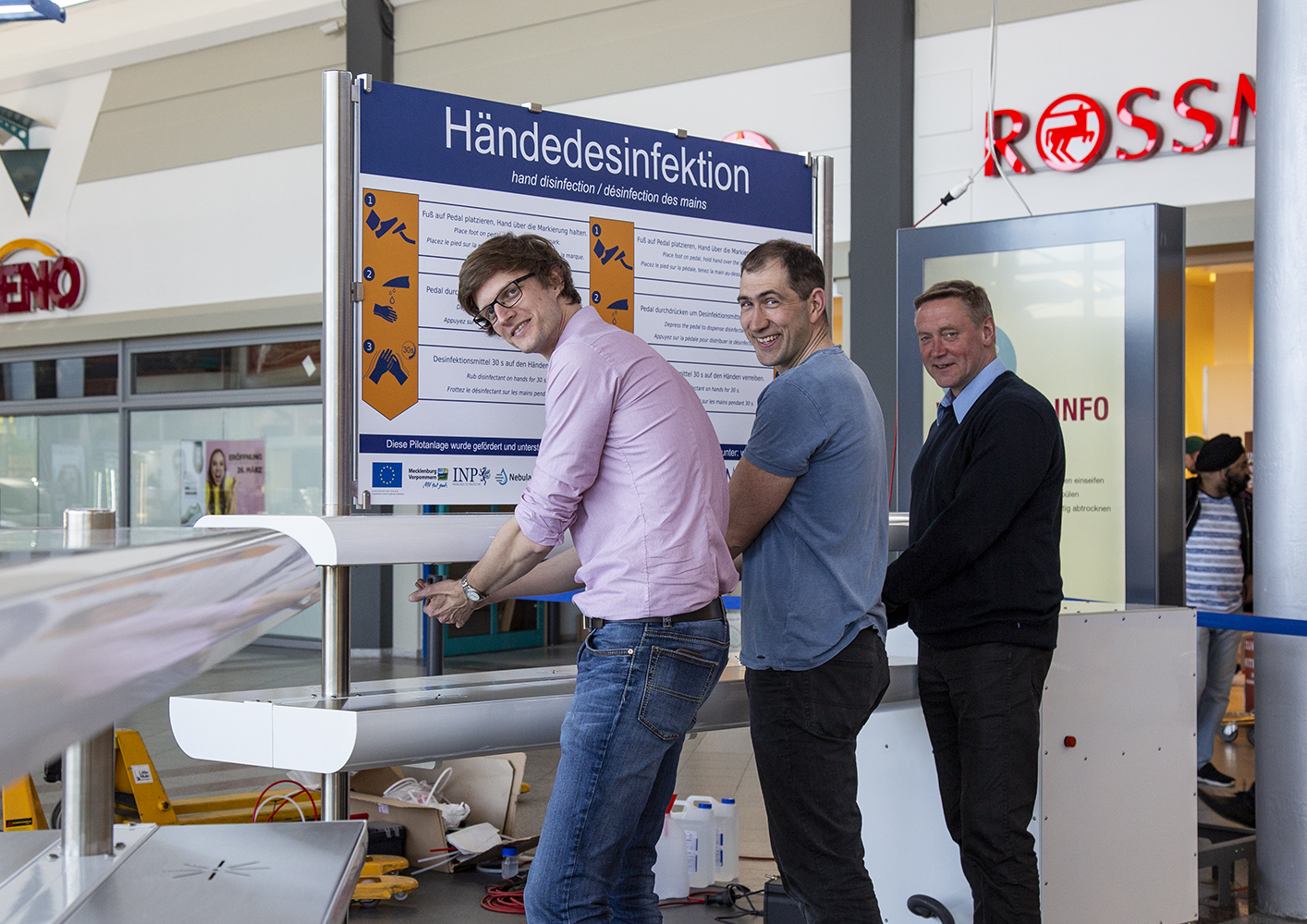
Researchers at the Leibniz Institute for Plasma Science and Technology (INP) in Greifswald are developing a new type of disinfectant and presenting a pilot plant for hand disinfection.
In the wake of the coronavirus pandemic, a new disinfection process developed by Nebula Biocides GmbH, a spin-off of the Leibniz Institute for Plasma Science and Technology (INP), is gaining in importance. The first pilot plant was presented yesterday during a test run at the Elisen Park shopping centre in Greifswald.
"Since 2016, we have been researching a highly effective disinfectant that works within 30 seconds against both stubborn bacterial spores and resistant viruses," explain Dr Jörn Winter and Dr Ansgar Schmidt-Bleker, researchers at INP and managing directors of Nebula Biocides GmbH. "Based on this process, we are working on a new type of disinfection system that allows hand disinfection in highly frequented locations such as train stations, airports, schools and hospitals," say the two researchers. The dispenser system is specially designed for public places where many people come into contact with each other. "The health and safety of our customers is always our top priority. Hygiene is of course extremely important, especially in the current situation, and since this week, a few more shops have been allowed to reopen at Elisen Park Greifswald. We are therefore particularly pleased to be able to introduce this innovative disinfection method to our customers at this time," said Karin Rüdiger, Centre Manager at Elisen Park. The pilot system already allows 18 people to disinfect their hands at the same time. The disinfection system has a modular design and is self-sufficient except for the water supply. The active ingredient is produced directly in the device from concentrates. This means that approximately 1 million hand disinfections can be carried out with a single concentrate filling. The process is therefore ideal for all locations with high public traffic.
Previous disinfectants are mostly alcohol-based, expensive and highly flammable. In addition, standard disinfectant dispensers require intensive maintenance and are not protected against vandalism. The two-component disinfectant system "Sporosan" from Nebula Biocides GmbH is not only effective against all pathogens, but also extremely cost-effective at around 10 cents per litre. This is 100 times cheaper than the current price per litre for alcohol-based hand disinfectants. In addition, the innovative disinfectant is water-based and, unlike conventional solutions, is non-flammable. After hand disinfection, the active ingredients break down into water and natural residues, making them completely biodegradable. A particular advantage of this rapid decomposition is that it makes theft of the active ingredient impossible, as has been observed frequently in hospitals and other public institutions in recent times ( ).
In years of preliminary investigations by INP and Nebula Biocides GmbH, the effectiveness, basic compatibility and safety of the process have already been confirmed in accredited laboratories – however, the process has not yet been approved. "We submitted a request for preliminary talks to the responsible Federal Institute for Occupational Safety and Health (BAuA) at the beginning of 2019," reports Dr Schmidt-Bleker. However, the BAuA stated that it "cannot undertake the assessment due to limited capacity".
Close cooperation with the relevant state ministries is currently underway to determine how the disinfection system can be made available to the public as quickly as possible. This would require the approval process to be initiated quickly or a special permit to be granted. Until then, the disinfection system can also be operated using conventional means. "This is not nearly as efficient and cost-effective as our active ingredient, but it is an important step towards improving hygiene in public places," said Dr Jörn Winter. The founders hope that the disinfection system can go into series production as soon as possible and thus help to contain the current coronavirus pandemic.
The development of the dispenser system was funded as part of the Mecklenburg-Western Pomerania Health Economy Ideas Competition. Other supporters include BSG Sondermaschinenbau GmbH and Formitas AG, the hygiene institutes Dr. Brill + Partner GmbH and Hygiene Nord GmbH, and Witeno GmbH.
Scientifical contact:
Dr. Jörn Winter - Leitung Gruppe Plasmaquellen
Tel.: +49 3834 - 554 3867
winter@inp-greifswald.de
www.leibniz-inp.de