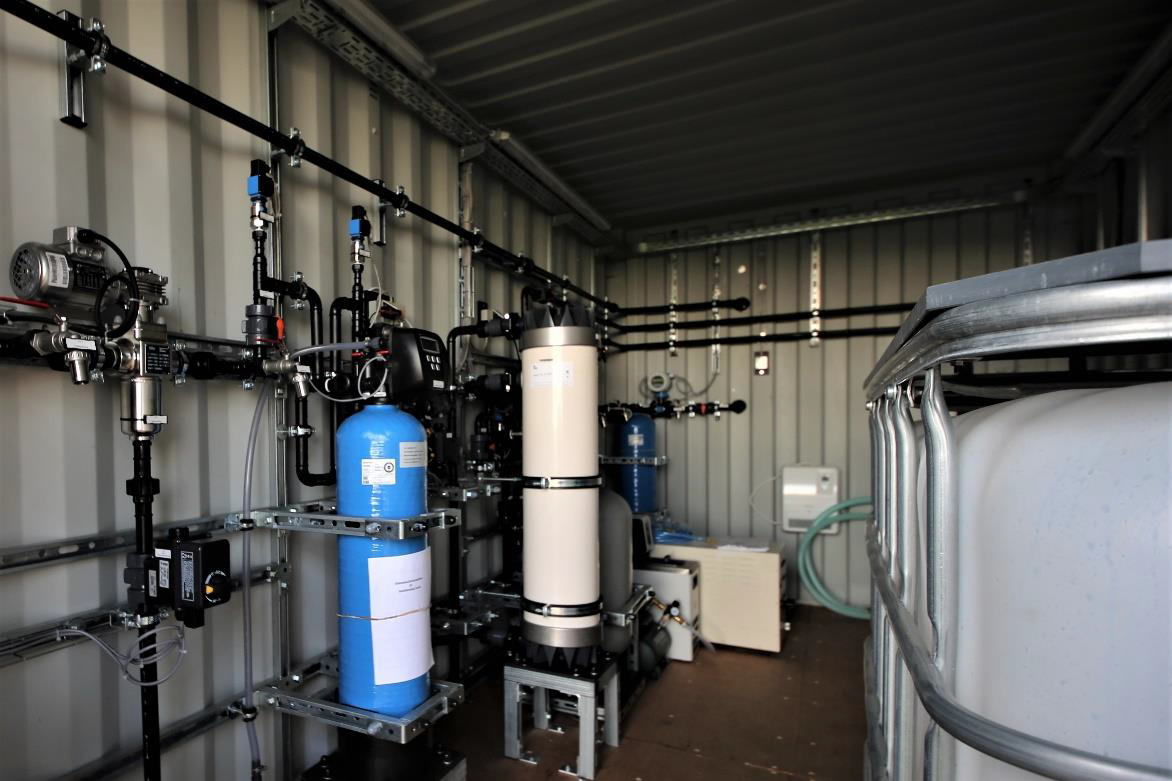
The PHYSICS FOR FOOD research project is testing innovative physical processes for water treatment at its practical partner Cosun Beet Company (CBC) in Anklam.
Only around three percent of the water available worldwide is drinkable fresh water. The extreme weather events that have become increasingly frequent in recent years, such as heat waves and droughts, are making it clear even in this country how valuable this resource is. At the same time, large quantities of water are needed to produce food. Innovative physical processes could help reduce the demand for fresh water in food processing through water treatment and water recycling. The removal of particles and germs also reduces the environmental impact of wastewater. Following successful laboratory trials, the PHYSICS FOR FOOD research project is now starting a practical test at the Anklam factory ( ).
The aim is to remove environmentally harmful substances and germs from the process water used in sugar production using a novel combination of various physical processes such as mechanical filters, activated carbon, ultrasound, ozonation, UV treatment and pulsed electric fields (PEF). In addition, a special plasma technology will be used to render pesticides and pharmaceutical residues harmless by means of dielectric barrier discharge (DBE). The various modules will be tested for their effectiveness on different types of wastewater during the course of the project. The mobile demonstrator can purify up to 2,500 litres of wastewater per hour. The plant makes it possible to test the effect of the various processes used on the respective water composition individually and in combination in order to prepare the optimal design of large-scale applications for different areas of use.
Environmentally friendly water treatment processes thanks to innovative technologies
The scientific director of the project, Prof. Dr. Jürgen Kolb from the Leibniz Institute for Plasma Science and Technology (INP), explains: “The treatment of water in food production and agriculture offers enormous ecological and economic potential. We are looking for new ways to either reuse wastewater directly in the production process or return it to nature in a clean state. By combining classic water treatment processes with innovative technologies such as plasma, ultrasound and pulsed electric fields, we can very efficiently remove germs, agrochemicals and pharmaceuticals from the water, thus keeping them out of groundwater or surface waters. In addition to food production, we also see potential applications in plant breeding, animal husbandry and in hospitals.”
Cosun Beet Company is involved as a practical partner and operator of the Anklam sugar factory. The plant in Mecklenburg-Western Pomerania currently processes around 1.8 million tonnes of sugar beet per year. In addition to granulated sugar, the factory also produces animal feed, bioethanol and biomethane from the sugar beet, which is fed into the natural gas grid as a renewable energy source. Miriam Woller-Pfeifer, process engineer at CBC Anklam, comments: “Our goal is to achieve a complete circular economy in sugar beet processing. We want to make optimal and sustainable use of all components. Water treatment is a central part of our sustainability strategy.”
In addition to Cosun Beet Company GmbH & Co. KG and the Leibniz Institute for Plasma Science and Technology e.V. (INP), Harbauer GmbH and Power Recycling Energyservice GmbH. The project, which is funded by the Federal Ministry of Education and Research and will run until the end of 2022.
About PHYSICS FOR FOOD
The Neubrandenburg University of Applied Sciences, the Leibniz Institute for Plasma Science and Technology (INP) and Ceravis AG launched the project 'PHYSICS FOR FOOD – A REGION THINK AGAIN!'. Together with partners, the alliance is developing new physical technologies for agriculture and food processing. Atmospheric pressure plasma, pulsed electric fields and UV light. The objectives are to reduce the use of chemical agents in protecting seeds and crops and strengthening plants against the effects of
climate change. PHYSICS FOR FOOD is also working on new processes for optimising agricultural raw materials and reducing pollutants in food production. Funded by the Federal Ministry of Education and Research as part of the 'WIR! – Change through
Innovation in the Region', the project ensures technology transfer and secures jobs jobs in the coastal hinterland of Mecklenburg-Western Pomerania (funding code 03WIR2803).