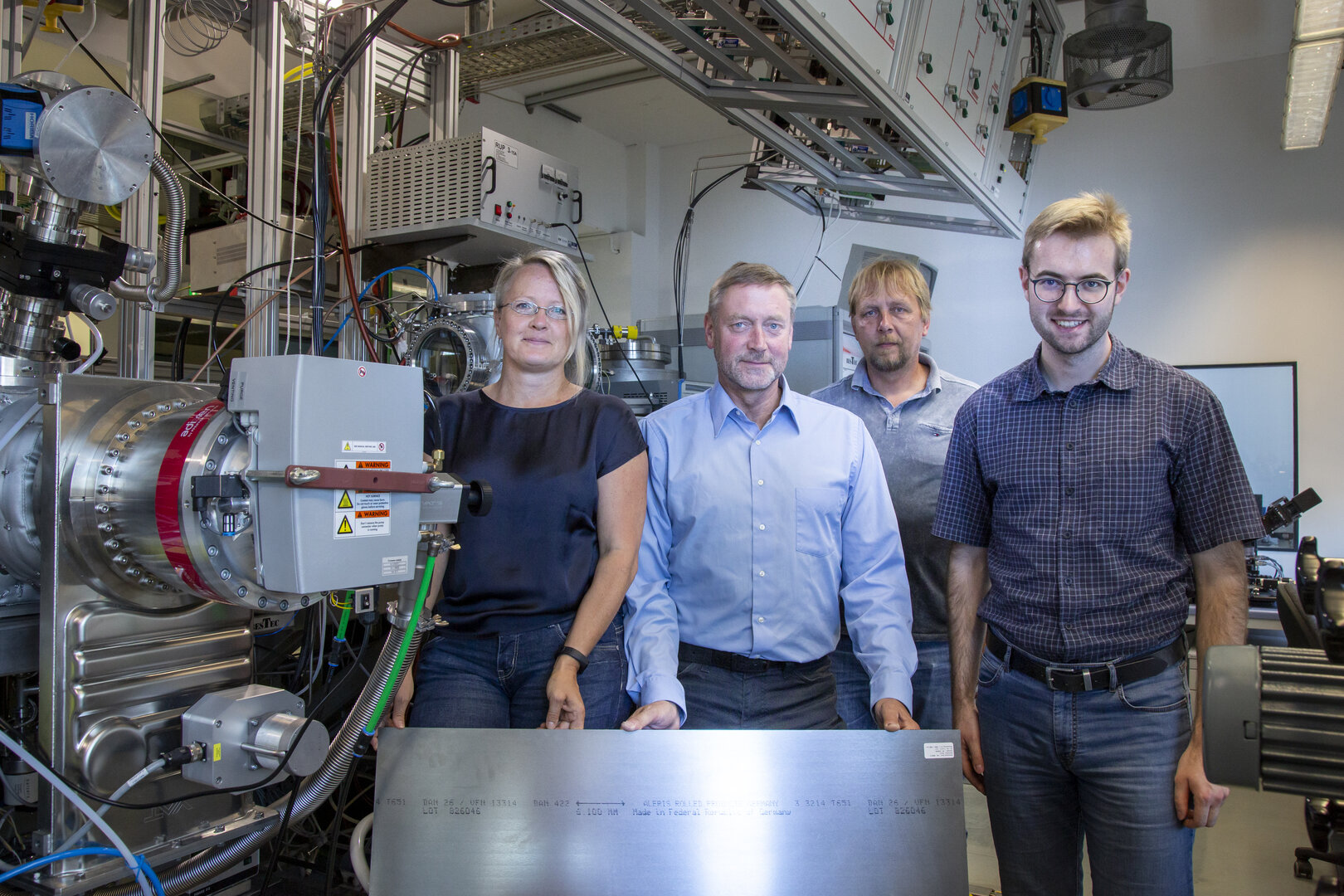
The research project "H2BS – Novel barrier layers for cost-effective and high-strength steels for hydrogen technology" is providing new impetus in hydrogen technology. Together with the Helmholtz-Zentrum Geesthacht – Centre for Materials and Coastal Research (HZG) and the Max Planck Institute for Iron Research (MPIE) in Düsseldorf, the Leibniz Institute for Plasma Science and Technology (INP) in Greifswald is researching novel hydrogen barrier layers for use on cost-effective and high-strength steels.
Hydrogen is one of the main players in the energy transition. The possibility of producing it from water and renewable energy sources such as wind and solar power using electrolysers makes it an ideal green energy storage medium. Hydrogen can also be stored and distributed in proportion to demand in the existing gas network. As a fuel for emission-free fuel cell vehicles, hydrogen is already an integral part of the mobility of the future. Due to its relatively low energy density ( ), hydrogen must be stored and transported in gaseous form under high pressure or in liquid form. In order to establish hydrogen as the energy carrier of the future, innovative solutions are therefore needed for safe and efficient storage and handling under the conditions mentioned above. Safe, volume-efficient, lightweight and cost-effective solutions are required for this purpose.
High-alloy steels, carbon-based or polymer-based materials are mainly used in existing tanks, pipes and fittings. However, these are either expensive or permeable and associated with high fuel loss rates. More cost-effective steels are subject to hydrogen-induced corrosion. This involves hydrogen penetrating the steel structure, causing the material to become brittle and crack. This means that these materials are currently unsuitable for storing hydrogen. This is precisely where the scientists from the three research institutions come in. Over a period of 24 months, they are working together to develop plasma processes for the production of so-called barrier layers, which are designed to prevent hydrogen from penetrating the steel surface. If successful, this will enable the use of lower-cost steels, which have not previously been considered for hydrogen technology, in the manufacture of hydrogen tanks and other components for the hydrogen infrastructure, thereby enabling more affordable systems for mobile and stationary hydrogen applications.
- part of the project, the INP is developing vacuum and atmospheric pressure-based plasma processes for coating and treating the surface. "The challenge is to create a coating with the properties required for hydrogen storage," explains project manager Dr Angela Kruth, head of the "Materials for Energy Technology" research group at INP. The result must "withstand the significant requirements such as extreme pressure ranges under which hydrogen is used today, for example in mobility". In investigations based on state-of-the-art structural analyses using electron microscopy at the MPIE in Düsseldorf, the first results of the barrier coating are already visible on an atomic scale. The stability of the steel will then be investigated in more detail before and after hydrogen storage in micromechanical tests at the MPIE and under hydrogen storage conditions in high-pressure permeation measurements at the HZG.
The joint research work focuses in particular on the storage of hydrogen in metal hydrides – a promising alternative to high-pressure and cryogenic tanks. By combining metals with hydrogen, known as metal hydrides, an astonishing amount of gas can be absorbed, meaning that twice as much hydrogen can be stored in a container of the same size. The Helmholtz Centre in Geesthacht is a leader in the field of metal hydride development. At the HZG's Hydrogen Technology Centre, the effectiveness of the coating against embrittlement can be tested and evaluated under real conditions.
"We are delighted to be opening up new avenues for hydrogen technology with this interdisciplinary network of experts," says Dr Kruth. At the end of the project, the fundamentals for a coating process for producing barrier layers with defined properties should be available. These will protect the various steel materials sufficiently against the diffusion of hydrogen in and through them in accordance with the planned operating conditions, thus successfully preventing embrittlement. In a follow-up project, these coating technologies will then be optimised for specific, real-life components in hydrogen technology, both for stationary storage tanks and for maritime mobility and other hydrogen systems.
The project is being supported by an industry committee comprising experts from the automotive and mechanical engineering sectors and is funded by the German Federal Ministry for Economic Affairs and Energy through the German Federation of Industrial Research Associations (AiF) as part of the programme for the promotion of industrial collective research and development (IGF).