Measurement of absolute ion densities (MAID) by evaluation of ion acoustic waves in the plasma as well as accompanying modeling for identification of the ions
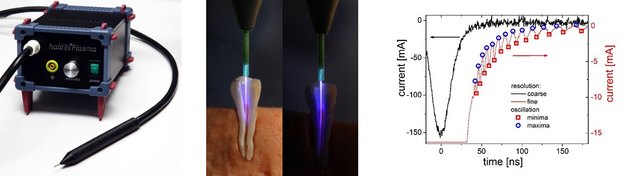
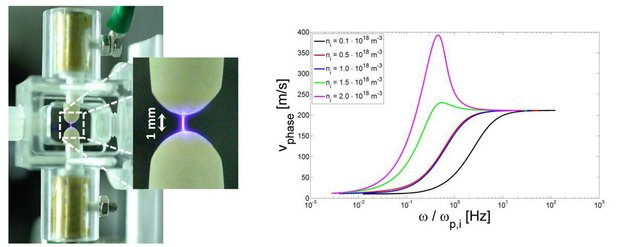
The project aims to measure the absolute ion density (MAID) by experimentally acquired high frequency current signals. It is funded by the Deutsche Forschungsgemeinschaft (DFG, 466331904) via Sachbeihilfe. Despite atmospheric pressure plasma discharges being investigated intensively since over a decade, the determination of absolute ion densities still proves a challenging topic in plasma diagnostics. The common approach with commercial mass spectrometers deliver relative values and actinometry as well as modelling deliver absolute ion densities while requiring specific boundary conditions.By evaluating self-excited ion acoustic waves (IAW) in the plasma, the proposed project addresses the determination of absolute ion densities by current signal measurement. Previous results and calculations show the existence of oscillations on the current signal once the ion densities cross a lower threshold [1,2]. The evaluation of the oscillation frequency equal to the plasma ion frequency revealed the absolute ion density with a high time resolution within nanoseconds [3].
The presented project addresses the following scientific questions:
- Is there a correlation between occurrence of IAW and the ion polarity or gas composition; is it possible to observe IAW generated by negative ions?
- Is the nature of IAW excitation based on self excitation or an external excitation purely due to the fast rising current pulse of the transient spark?
- Is it possible to observe an IAW within a single filament of the dielectric barrier discharge (DBD) and which parameters can be determined?
- Is it possible to observe IAW within modeling results?
- Is an external excitation of IAW possible and could this allow a tuning of the detection limit?
Aside from the application of the proposed diagnostic on the already successful transient spark discharge, the investigation of a dielectric barrier discharge (DBD) with a broader scientific database is targeted. The DBD allows the operation at different gases including admixtures. By accompanying modelling the expected ion densities and dominant ions will be calculated to support ion identification. At the end of the project the until now passive diagnostic shall be converted into an active diagnostic by coupling a high frequency excitation into the electrical system. An active diagnostic might allow the ion density measurement at any desired plasma setup.
[1] Gerling, T. (2014). Beiträge zur optischen und elektrischen Charakterisierung des dynamischen Verhaltens von Plasmaspezies in Atmosphärendruck-Plasmen [Ernst-Moritz-Arndt University Greifswald]. https://epub.ub.uni-greifswald.de/frontdoor/deliver/index/docId/1395/file/PHDThesis_bib_ABGABE.pdf
[2] Gerling, T., Bussiahn, R., Wilke, C., & Weltmann, K.-D. (2014). Time resolved ion density determination by electrical current measurements in an atmospheric pressure argon plasma. Europhys. Lett., 105, 25001. https://doi.org/10.1209/0295-5075/105/25001
[3] Gerling, T., Wilke, C., & Becker, M. M. (2020). Fast electrical diagnostics and dispersion relation for ion density determination in an atmospheric pressure argon plasma. Journal of Physics D: Applied Physics, 54(8), 85201. doi.org/10.1088/1361-6463/abc5e8
[4] Bussiahn, R., Brandenburg, R., Gerling, T., Kindel, E., Lange, H., Lembke, N., Weltmann, K.-D., von Woedtke, T., & Kocher, T. (2010). The hairline plasma - an intermittent negative dc-corona discharge at atmospheric pressure for plasma medical applications. Applied Physics Letters, 96(14), 143701. doi.org/10.1063/1.3380811
[5] Höft, H., Kettlitz, M., Hoder, T., Weltmann, K.-D., & Brandenburg, R. (2013). The influence of O 2 content on the spatio-temporal development of pulsed driven dielectric barrier discharges in O 2 /N 2 gas mixtures. Journal of Physics D: Applied Physics, 46(9), 95202. stacks.iop.org/0022-3727/46/i=9/a=095202
Project Management Board: