Functional nanocomposites
Plasma-based deposition techniques open up versatile routes to create functional nanocomposites which contain an arrangement of multiple nanoscale components, such as nanoparticles. At INP, the research programme Surfaces and Materials develops innovative approaches to fabricate functional nanocomposites with applications in bio-inspired electronics, sensing and photonics.
Nanogranular matter, employing a network of distributed metal nanoparticles, is of particular interest for bio-inspired electronics and potential applications as physical reservoirs for in-materia reservoir computing. State-of-the-art gas phase synthesis and nanoparticle beam deposition is used to create nanogranular networks, which are poised at the threshold of percolation. These nanogranular networks exhibit collective resistive switching with dynamic transitions between multiple resistance states, which trace back to local rearrangements in the current paths throughout the network. To tailor stability and spatio-temporal properties of resistive switching, nanoparticulate systems can be combined with solid encapsulation or liquid host media.
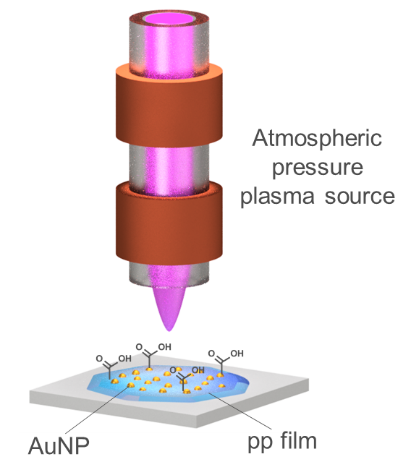
Plasma-polymerized nanocomposites, created by combining monomeric precursors with metal and non-metal nanoparticles, are of interest for fields such as biosensors, optics and microelectronics. In particular, the incorporation of metal nanoparticles, like gold, into plasma-polymerized (pp) thin films can enhance signal amplification for biosensors. This enhancement is due to the nanoparticles' high conductivity, catalytic properties, stability, and biocompatibility, which complement the inherent function of the pp films in immobilizing bioreceptors.