The comparability of research results has been a topic of discussion in the scientific community for many years. Despite identical test setups with clearly defined experimental parameters, different results are often obtained. The reasons for this are complex.
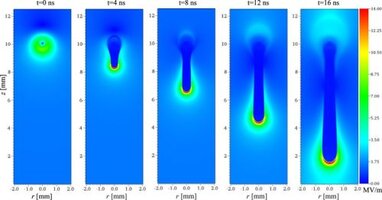
Even computer simulations show considerable deviations. This is shown by a recent study conducted by seven renowned research institutes and universities in Germany, Belgium, France, Spain, China and the Netherlands, in which scientists from the Leibniz Institute for Plasma Science and Technology (INP) in Greifswald also participated. The topic was a comparison of six simulation codes for positive streamer discharges. These plasmas are used, among other things, to break down pollutants or treat chronic wounds. Due to their complexity, simulating streamer discharges is a major challenge.
Within the study, four groups used a code they had implemented themselves, while two other teams used the commercial simulation software COMSOL Multiphysics®. Three simple discharge situations were simulated in dry air at 1 bar and 300 K. The transport coefficients and fluid models used were also identical. The investigations showed that the results in the standard grid resolution differed significantly from one another. In the first test with a relatively high background density of electrons and ions without taking photoionisation into account, significant differences in streamer velocities and maximum electric fields were recorded. Only the use of finer grids led to acceptable agreements between the codes.
In the second test case – with a low background ionisation density – there were deviating streamer properties and numerical instabilities. Here, too, only a finer grid resolution led to consistent results. In a third investigation, various common approaches to modelling photoionisation were compared and evaluated. Here, it was found that numerical parameters, such as grid resolution, play a greater role in differences in simulation results than the photoionisation model.
In their article "Comparison of six simulation codes for positive streamers in air" in Plasma Sources Science and Technology Vol. 27 No. 9 (2018), the researchers have now described in detail the calculation times, the hardware used and the numerical parameters for each code. The study is therefore of great importance as it provides a reference example for the comparability of simulations in plasma physics. On this basis, further mathematical models and simulation tools for streamer discharges can be investigated in the future.
Original publication:
B. Bagheri, J. Teunissen, U. Ebert, M. M. Becker, S. Chen, O. Ducasse, O. Eichwald, D. Loffhagen, A. Luque, D. Mihailova, J. M. Plewa, J. van Dijk and M Yousfi (2018). Comparison of six simulation codes for positive streamers in air. Plasma Sources Sci. Technol. 27 (2018): 095002.https://doi.org/10.1088/1361-6595/aad768
Scientific contact:
Prof. Dr. Ronny Brandenburg
Head of the research programme "Plasma Chemical Processes"
Tel.:
Email: brandenburg@inp-greifswald.de