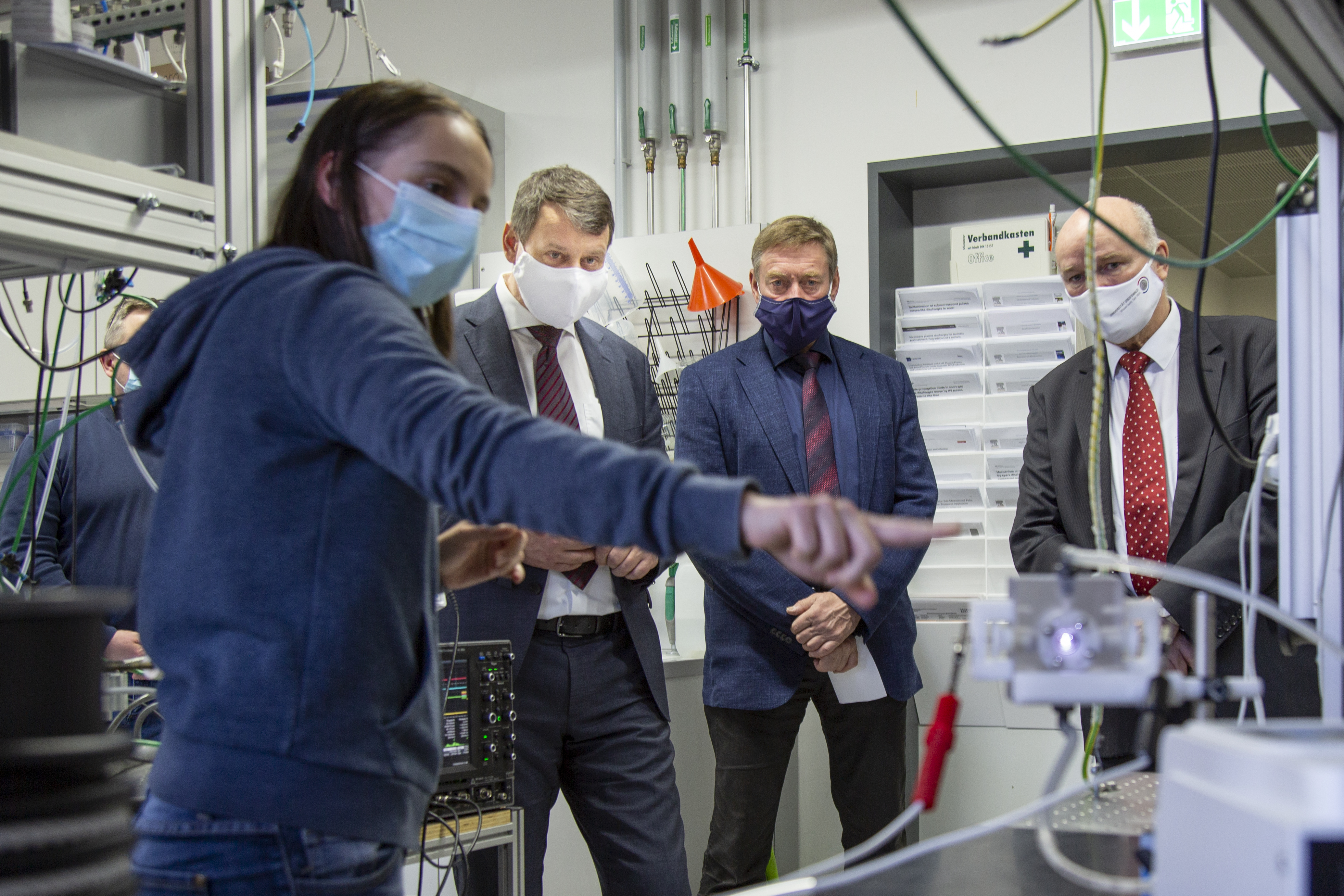
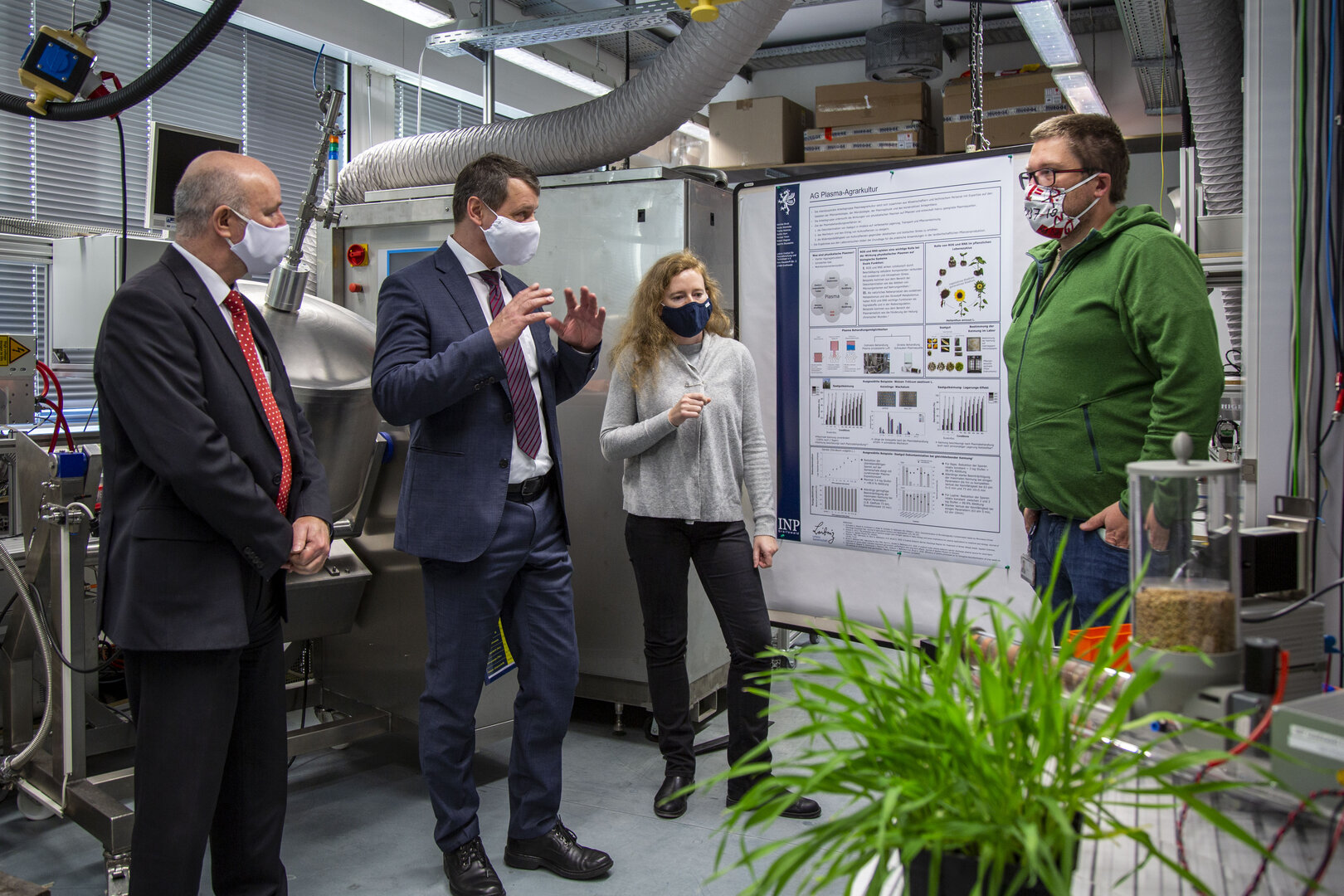
The aim of the visit by Michael Sack, District Administrator of the Vorpommern-Greifswald district and State Chairman of the CDU Mecklenburg-Western Pomerania (M-V), and Egbert Liskow, CDU member and member of the State Parliament of M-V, is to gain an overview of the latest developments in the field of hydrogen technology and plasma medicine. District Administrator of the Vorpommern-Greifswald district and State Chairman of the CDU Mecklenburg-Western Pomerania (M-V), and Egbert Liskow, CDU member and member of the M-V state parliament, to the Leibniz Institute for Plasma Science and Technology (INP) e. V.
The Leibniz Institute for Plasma Science and Technology (INP) is Germany's leading institution in the field of Plasma Science and Technology, combining basic research and applications.
The programme on 23 November will feature the presentation of the latest developments in surface analysis, a special field of the INP. Scientists from the Plasma Surface Technology Department will provide an insight into plasma-assisted processes for modifying surfaces for use in the high-tech sector, such as automotive engineering, the aerospace industry and in the life sciences, e.g. for implants or in the food industry.
One of the key projects to be presented is the CAMPFIRE Alliance North-East, led by INP e.V. in cooperation with 40 partners as part of the WIR! pilot programme – "Change through Innovation in the Region" of the Federal Ministry of Education and Research (BMBF). It pursues the development of new technologies for the decentralised production of green ammonia (NH3) from renewable energies and its use as an innovative energy source for emission-free maritime mobility. Electroceramic thin-film membranes based on complex metal oxides form the core of CAMPFIRE's new energy technologies.
Information on the development and optimisation of plasma-based processes for decontamination and hygiene for environmental protection is also on the agenda for the CDU politicians' visit to the INP. State-of-the-art plasma technology is used to break down biological and chemical contaminants from surfaces, gases and liquids. Physical plasmas can contribute to the destruction of stubborn compounds such as pharmaceutical residues in wastewater treatment and are used in drinking water treatment.
With the project "Physics for Food – A Region Rethinks!", the INP, together with the Neubrandenburg University of Applied Sciences and its partners, is pursuing the development of a strategy to make seeds more viable and robust with the help of physical technologies. The focus here is, for example, on the application of cold plasmas to accelerate plant growth and increase resistance. "Physics for Food" is funded by the BMBF as part of the "WIR" funding programme – Change through Innovation in the Region.